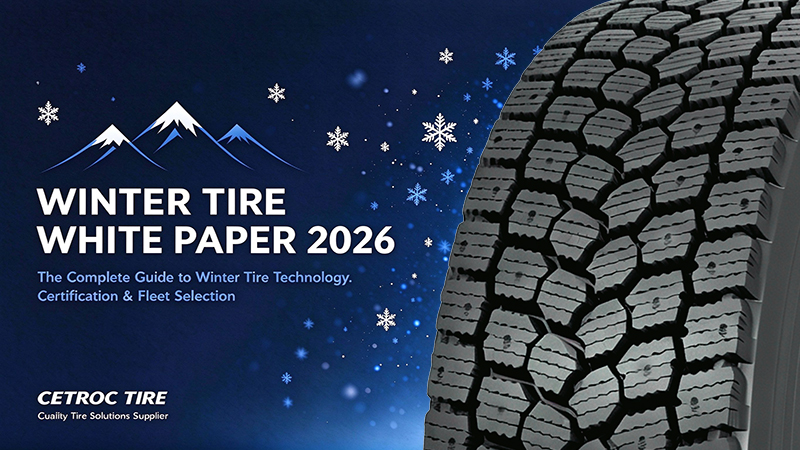
WINTER TIRE WHITE PAPER 2026
Overview
For fleets operating in cold climates, winter tires are a safety essential, not an option. This guide covers core technology, 3PMSF standards, and selection criteria.
Key takeaways:
All-season tires harden below 7°C, losing up to 30% grip
Winter tires stop 10–15m shorter on ice
Quality winter tires last 2–3 winter seasons
3PMSF Certification
What is 3PMSF?
3PMSF = Three Peak Mountain Snow Flake — an international snow performance certification mark on the tire sidewall, indicating the tire passed standardized snow traction testing.
Certification requirements:
Pass packed-snow traction testing
Minimum snow traction index of 110 (10% better than reference)
ASTM F1805 (North America) or ECE R117 (Europe) standards
Regulatory requirements:
Germany, Austria, France, Scandinavia, and other European regions legally require 3PMSF-certified tires in winter. M+S-only tires without 3PMSF do not meet modern winter standards.
Winter vs All-Season Tires
Compound difference
All-season: Broad-range compound, hardens below 7°C, sharp grip loss
Winter: High-silica special compound, stays flexible at -20°C, strong cold grip
Tread difference
Winter tires feature:
Deeper tread — 10–12mm (vs 8–10mm all-season), superior snow evacuation and bite
High-density sipes — thousands of microscopic cuts creating ice-biting edges
Wide grooves — effectively evacuate snow, slush, and water
Performance comparison

The 7°C rule
Switch to winter tires when temperatures stay below 7°C — don't wait for snow. European fleets typically mount in mid-October and remove in late March/early April.
Selection & Replacement
Tread depth thresholds
10–12mm: New, optimal performance
7–9mm: Good, safe
4mm: Minimum standard, plan replacement
Below 3mm: Dangerous, replace immediately
Axle position priority
Steer: Most critical, new tires first, replace at 4mm
Drive: Maximum traction needed, deep lug winter patterns
Trailer: Winter-rated still required, 3mm minimum
Three selection factors
1. Certification: Must have 3PMSF symbol
2. Pattern matching application:
Long-haul highway → regional winter pattern, 10–11mm
Mixed routes → all-position winter drive pattern, 11mm
Severe snow/mountain → deep traction lugs, 12mm+
3. Casing quality: High-tensile belts, strong bead, retreadable design
Cost evaluation
Evaluate cost per kilometer, not sticker price:
Purchase + mounting + maintenance + repairs) ÷ total winter km
Premium winter tires cost 15–25% more upfront but last 20–30% longer and are retreadable — lower long-term cost.
Winter Tire Maintenance
Check cold pressure weekly — pressure drops ~0.1 bar per 10°C
10% under = +1–2% fuel; 20% under = -30% tire life
Regularly inspect cuts, punctures, sidewall bulges, irregular wear
Clear snow/ice from dual wheel assemblies
Store cool, dry, away from ozone sources
CETROC ICE WARRIOR B Range
Core technologies:
3PMSF certified — meets European winter regulations
11mm deep tread — superior snow bite, extended winter life
High-silica winter compound — flexible grip at -20°C
3D interlocking sipes — high-density biting edges, strong ice performance
Heavy-duty casing — high-tensile belts, retreadable sizes
Main sizes:
Steer/All Position: 295/80R22.5, 315/80R22.5, 315/70R22.5, 385/65R22.5
Drive: 295/80R22.5, 315/80R22.5, 315/70R22.5, 13R22.5
Manufacturing & certifications:
Three manufacturing bases — China, Thailand, Cambodia
FAQ
Q: Are M+S tires winter tires?A: No. M+S has no standardized test; only 3PMSF certifies snow performance.
Q: Can winter tires be used year-round?A: Not recommended — they wear ~50% faster in summer heat with reduced handling.
Q: How many seasons do winter tires last?A: Typically 3–5 winters; replace based on tread depth.
Q: Winter tires on all positions?A: Yes — mixing creates unsafe, unbalanced handling.
Conclusion
Look for 3PMSF — certified performance and regulatory compliance
Switch at 7°C — don't wait for first snow
Match pattern to route — select winter pattern by application
Replace at 4mm minimum — ensure snow safety
Evaluate cost per kilometer — premium tires cost less long-term
Learn More
Email: marketing@cetroc-tire.com
Website: www.cetroc.com
“CETROC QUALITY TIRE SOLUTIONS SUPPLIER”